Where to Put Your Carry-On | and Why the Bin You Choose Matters
Published by FlyingWith3 min readText updated
Airline and government rules change. Check your airline's current rules before you travel.
FlyingWith editorial team
How we check our sourcesQuick answer
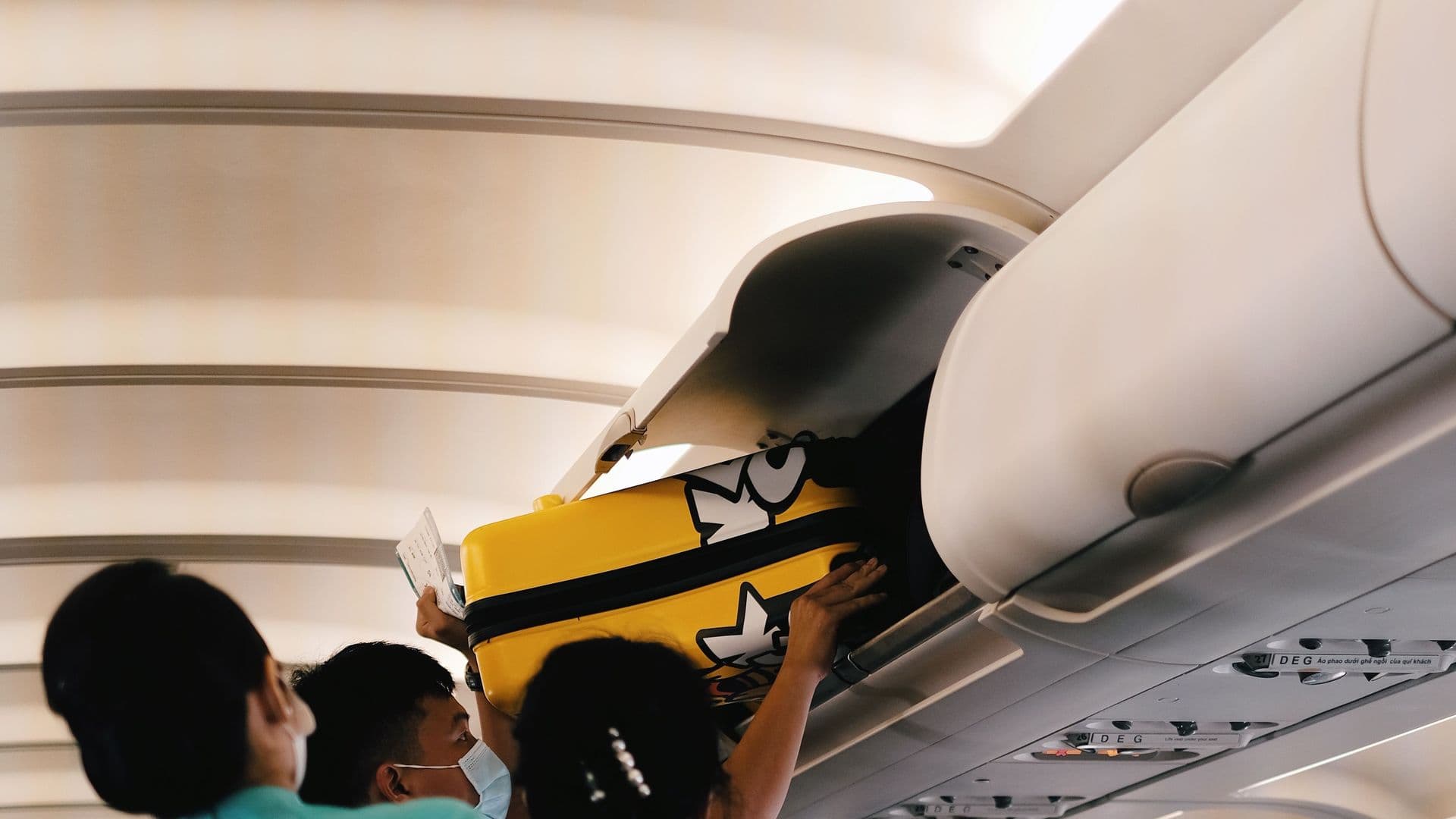
If you can, put your carry-on in the bin above your seat or slightly ahead of it, not behind you. It keeps your bag reachable when you land, instead of leaving you to fight the aisle or wait for it to clear.
In this guide(7)
Go straight to the part you need.
Choosing an overhead bin barely feels like a decision. It's worth treating it as one. Here's what makes the difference.
Part of: Flying for the First Time, Flying with Anxiety, Flying for Business
General advice: applies wherever you fly
Aim for the bin above you, or ahead of you
If you can, put your carry-on in the bin above your seat or slightly ahead of you, not behind you. It sounds like a small thing, but it matters when you land. If your bag is three rows behind, you either have to fight against everyone coming forward to get it or wait until the aisle clears. Neither is fun.
General advice: applies wherever you fly
A closed bin is a full bin
If you see a bin that's already closed, assume it's full. Don't reopen every closed bin looking for a tiny bit of space. Keep moving toward your seat and look for an open one. If everything nearby looks full, ask a crew member before putting your bag several rows away. It's a normal thing to ask, and sometimes there's space that isn't obvious, or a bag can be repositioned.
General advice: applies wherever you fly
Bulkhead seats: everything goes overhead
Bulkhead seats are the seats directly behind a wall or divider instead of another row of seats. Since there's no seat in front of you, there's nowhere to put a personal item for takeoff and landing. Your backpack, purse, laptop bag, everything, has to go overhead. That's why it's worth getting settled early if you're sitting there. Waiting until the bins around you are packed can mean your stuff ends up much farther away.
General advice: applies wherever you fly
If your bag gets gate-checked
When overhead space runs out, larger carry-ons can end up being checked at the gate. If that happens, take out anything you'll need before you hand it over: medication, chargers, documents, anything you can't be without for the next few hours. Once the bag goes, you won't see it again until baggage claim.
General advice: applies wherever you fly
Backpack or roller bag: what decides where it goes
Airlines sort the bags you bring into the cabin by size and by number, not by shape. Your ticket includes a personal item, the small bag that has to fit under the seat in front of you, and usually a carry-on as well. If a backpack is the only bag you bring into the cabin and it fits the carry-on size limit, it counts as your carry-on, whatever it is made of, and the bin is where it belongs. If you bring a roller bag too, the backpack is your personal item, and personal items belong under the seat.
So there is no written airline rule that reserves the bins for roller bags. What airlines publish is the two size limits and how many items you may bring into the cabin. But bin space is shared and it runs out, and that is where the arguments start. On a full flight, the crew will ask for anything that fits under a seat to go there first, so bags that fit nowhere else can still be stowed, and crew instructions during boarding have to be followed. Even a carry-on you paid for is not a promise of bin space: if the bins fill up, the bag is checked at the gate, normally at no extra charge.
Two paid extras do not change this. Extra legroom buys floor space, not bin space: the bin above an extra-legroom row is the same shared bin as any other. And bins cannot be divided evenly by seat: some are kept for emergency equipment and crew items, one bin spans several seats and holds fewer full-size bags than there are seats beneath it, and bulkhead rows have no under-seat space at all. If you checked your suitcase, say so calmly and early, before the bins fill. A backpack that is genuinely your only cabin bag is a carry-on, and crew can usually treat it as one when that is clear from the start.
General advice: applies wherever you fly
Small things that help everyone
A couple of small things help everyone. Put wheeled bags in the direction the bin is shaped for. Look at how the bags already in there are sitting. Don't spread a coat across half a bin; put it on top of your bag once the larger bags are in. And don't use a bin three rows back "just for now." There's a good chance that temporary spot becomes permanent.
General advice: applies wherever you fly
What it comes down to
The goal is simple: keep your bag close, keep the aisle moving, and make sure you can actually get to your stuff when you need it.
Share this guide
Saves a reading copy on this device, visible to anyone using it. Checklist answers and bookings are not saved. Browser storage can be cleared automatically; check your saved guides before travelling.
Put your next steps in one place
Build a checklist for the people travelling, then download a PDF or add a calendar reminder.
Build my trip checklistHelp keep this page accurate
Opens an email draft with this page’s public link. You can review it before sending.
Next step
Flying for the First TimeRelated guides
- Carry-On Checked at the Gate? What to Take Out FirstWhat has to come out of a bag going into the hold at the gate, what to keep with you, and what to ask about getting the bag back.
- Don't Lose Your Earbuds on the PlaneWhy a wireless earbud is one of the easiest things to lose on a plane, how to keep track of yours, and what to do if one falls into the seat.
- Before You Board: Three Things That Make It EasierHave your boarding pass open, carry your backpack in front of you, and use the terminal bathroom first. Three small habits that make boarding easier.
- Once You're Seated: Three Small CourtesiesReclining while the row behind you eats, why the crew stops serving hot drinks in turbulence, and why the belt stays loosely fastened when the sign is off.